
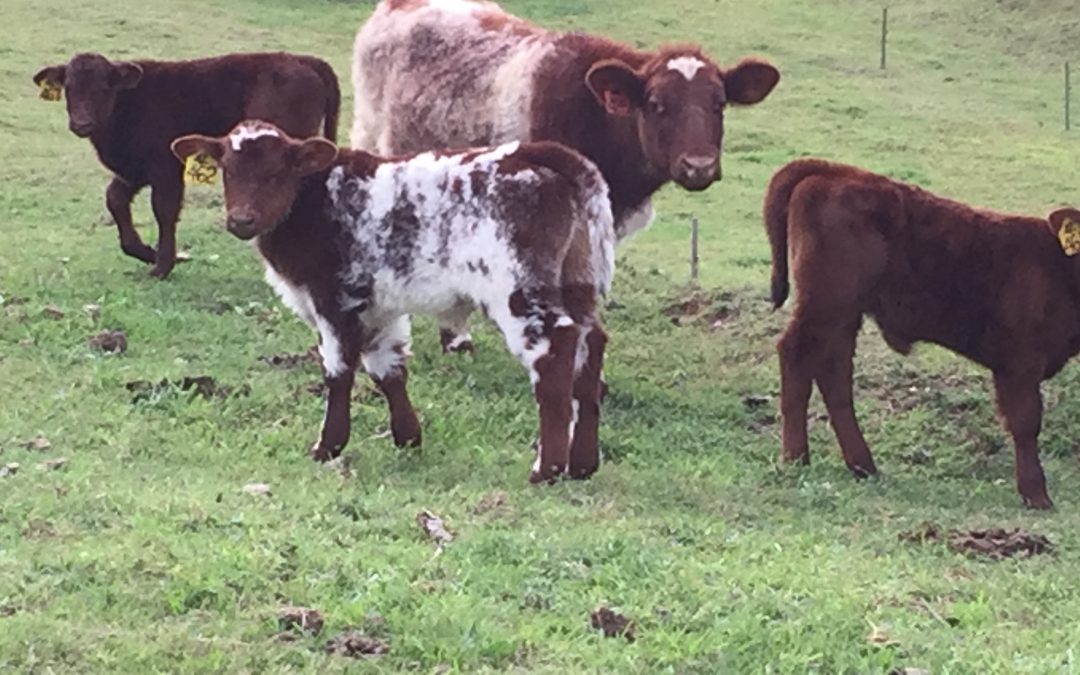
We often say that Shorthorns put the vigour in your hybrids. Here are the numbers behind that, from some of the longest-running crossbreeding trials in the world. Shorthorn was one of the three breeds in most of them.
Fort Robinson, Nebraska, 1957 to 1976
The USDA ran Angus, Hereford and Shorthorn cattle side by side for nearly twenty years. Crossbred calves out of straightbred cows weaned 8.5% more weight per cow put to the bull than straightbred calves did, mostly because more of them survived and they grew faster. Crossbred cows rearing crossbred calves did better again: 23.3% more calf weaned per cow exposed than straightbred cows with straightbred calves. Almost two-thirds of that gain came from the crossbred cow herself.
A lifetime at Clay Center
A follow-up study kept crossbred and straightbred Hereford, Angus and Shorthorn cows, born in 1960 and 1961, for their whole working lives. Over twelve years the crossbred cows weaned nearly one more calf each, and 25% more total calf weight. An economic study of the same cattle put the saving at about 12% of the cost of each unit of output from a three-breed British cross.
Shorthorn as the sire
In the late 1980s the Meat Animal Research Center mated bulls of eleven breeds to Angus and Hereford cows. Among the Shorthorn-sired calves:
- 99.6% were born unassisted, and the researchers noted that Shorthorn sires needed little calving help for the size of their calves;
- weaning weights were 102% of the Hereford-Angus crosses;
- heifers reached puberty at 338 days, second only to the Piedmontese crosses and two weeks ahead of the Hereford-Angus heifers;
- Shorthorn-sired cows weaned calves about 5% heavier than Hereford-Angus cross cows. That figure comes from a small, preliminary group of 43 cows, so we treat it with care.
It is also why we put our Bonsmara cows on Forest Glade to Shorthorn bulls. If you are running Bonsmara, Hereford, Angus or Nguni cows, a Shorthorn bull is a simple way to put that vigour to work. Give Allistair a call to talk it through.
Source: USDA-ARS Germplasm Evaluation Program, Progress Report No. 12, 1990