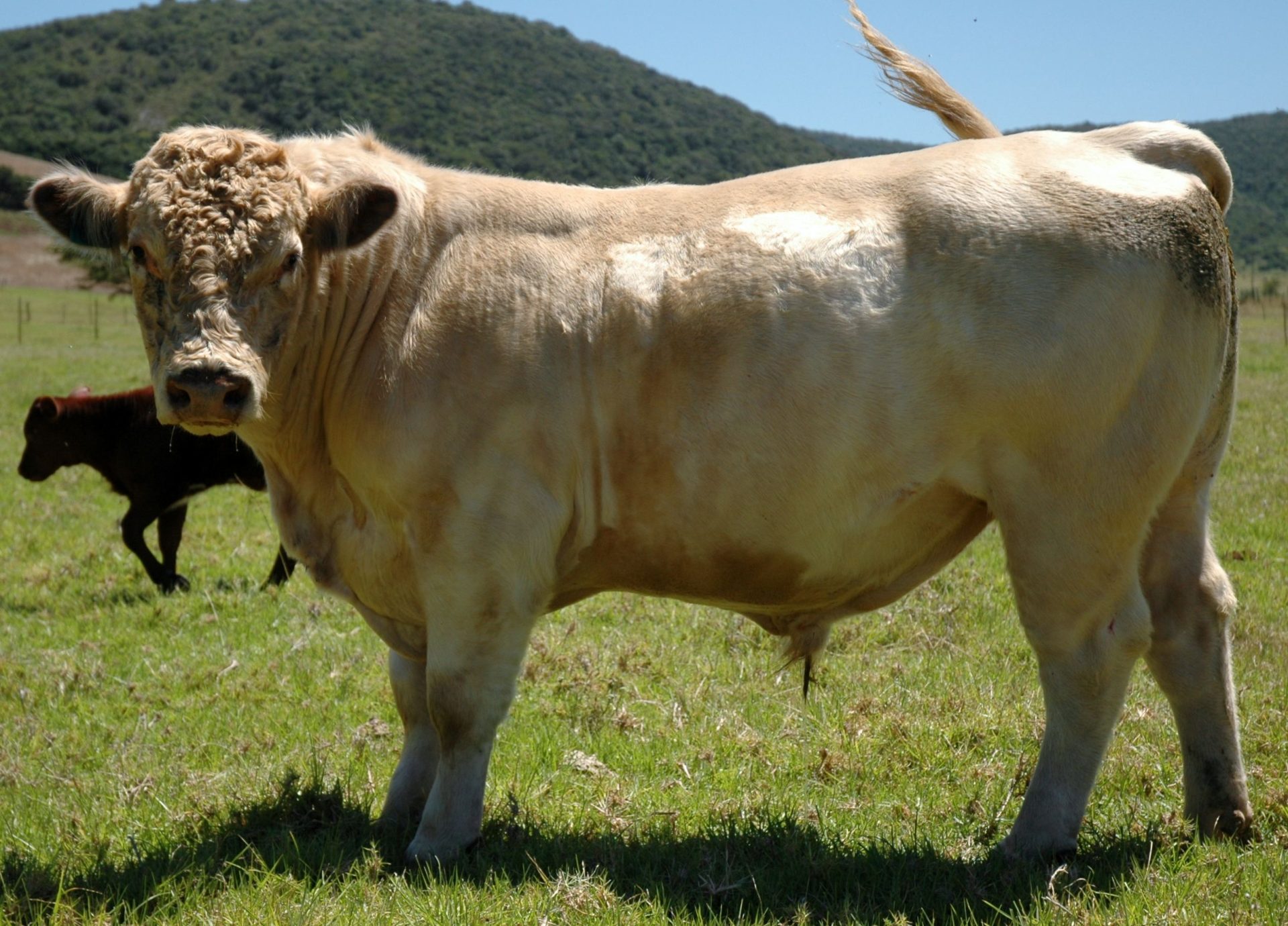
Blackstone Beef
Blackstone Beef was set up to farm beef commercially across the producer chain. We select hard for a herd that produces:
- Fertile, early-maturing female progeny
- Large, early-maturing weaners for the feedlot market
- Steers to about 450 kg on veld with little supplementation, slaughtered before 24 months (before wisseling)
- Aged stock that reach slaughter condition quickly after weaning
- Longevity, with bulls and cows still producing in their teens
We also want to produce consistent, commercially minded seed stock for stud and commercial breeders with the same goals.
From 2014, selected bulls are sold with an in-herd semen use interest (collected at the seller’s expense and the buyer’s convenience), with 50% of semen sale rights retained.
Read the full Blackstone Beef story
The Blackstone Beef Project was established as a vehicle for us to further our beef farming interests from a producer perspective. The objective is to produce beef on a commercial basis across the beef producer chain. With the given resources, we select rigorously for a herd that performs optimally by producing:
- Fertile, early maturing female progeny;
- Large, early-maturing weaners for the feedlot market;
- Growthy steers we can get to about 450kg with minimal supplementation on the veldt to slaughter at below 24 months of age (essentially before wisseling);
- Aged stock with doability to quickly and easily get to slaughter condition after weaning their calves; and
- Longevity of both males and females, to produce into their teen years.
As an aside, albeit an important factor, we also strive to produce consistent, quality, commercially-orientated seed stock and genetics for commercial and stud breeders looking to achieve similar objectives.
From 2014, some specified bulls will be sold with an in-herd semen use interest (collection at the seller’s expense and the buyer’s convenience) and 50% semen sale rights retained.
Breeding and selection policy
We are ruthless about culling poor performers. Selection is on performance, conformation and soundness.
Performance recording
S.A. Studbook registrations plus Phase A, B and C performance recording drive every selection decision.
A modified Lasater principle
We don’t cull a cow that loses her calf to something beyond her control, such as lightning, predators, snake bite or tick-borne disease.
Two seasons a year
We are close to the coast and rain is spread through the year. Each season starts with timed AI, followed by a strict 65 days, in May/June and November/December.
Read the full breeding and selection policy
Breeding and selection are the cornerstones of a successful operation. At Blackstone Beef, we take this very seriously, and are absolutely ruthless when it comes to culling poor performers. Selection is done based on animal performance as well as conformation and soundness, and for this purpose we utilise S A Studbook - Registrations as well as Phase A, B and C performance recording.
We also use a modified Lasater principle in that we do not cull if cows don’t wean a calf due to circumstances beyond their control, such as lightning strikes, calves killed by predators, snake bites and tick-borne diseases.
We breed twice annually to spread the load between spring and autumn. Being situated close to the coast, rainfall is fairly evenly spread throughout the year, so there are no predefined wet and dry seasons per se. Both breeding periods begin with timed AI, followed by a strict 65 day breeding season. The breeding periods are May/ June and November/ December each year.
How we measure the herd (from our 2017 website)
Selection is done on animal performance as well as conformation and soundness, and for this we have used two strict and impartial services:
- S A Studbook: registrations as well as Phase A, B and C performance recording, through BenguFarm BEEF, recording and analysing birth, 100-day, wean, 12-month and 18-month weights, as well as dam weights at each weaning.
- Falkirk Scientific Foundation: the cattle are ultrasound scanned for muscle, fat deposition and skin thickness, and the Falkirk Index is used to objectively analyse our animals for superior genetics for enhanced retail meat value. The cattle are also phenotypically selected for structural soundness as well as disposition. This happens at six-monthly intervals so that evaluation is not seasonally influenced.
Why Beef Shorthorns?
People often ask why we chose Shorthorns. We are in the beef business, so we wanted a breed fit for purpose. The British breeds produce good beef and are naturally fertile, easy calving and easy to work with. In South Africa, Shorthorns gave us the best chance to build a strong beef identity on the qualities that made the breed great.
Our focus has always been the commercial traits, mainly muscling and the hindquarter, without losing capacity, fertility or mothering ability. With input costs rising, we also want cattle that do well when conditions are poor and fatten on what the farm grows. That means more profit per hectare.
The two herds let us work with new genetics on one side and fine-tune traditional South African genetics on the other. We have been to Australia, Ireland and the UK looking at genetics.
Breed traits
Composite breeds developed from Shorthorns
Read the full Beef Shorthorns section
When we started breeding Beef Shorthorns in 2003, we were often asked why, out of all the breeds, we chose Shorthorns. The answer for us is fairly simple: we are in the business of beef, so start with a breed that is fit for purpose. That steered us towards the British breeds, as, in addition to producing quality beef, they are generally naturally fertile, easy calving, and importantly, easy to work with. Shorthorns, as a breed in South Africa, presented what we believed to be the greatest opportunity for us to shape a strong beef identity with all the original qualities that made Shorthorns great for generations in years gone by.
Other breed characteristics that are intrinsic to the Shorthorn identity are the availability of the polled gene, extremely strong maternal strengths including good milk, as well as longevity, early maturity, easy finishing, good disposition and virility. Finally, from a seed stock perspective, they also possess the undisputed ability to add hybrid vigour in cross-breeding programmes. Composite breeds developed from Shorthorns include the following popular breeds:
- Beefmaster,
- Bonsmara,
- Droughtmaster,
- Durham Reds, and
- Santa Gertrudis.
Our focus from the very first day has been on enhancing the commercial traits of the breed, primarily muscling, with an emphasis on the hindquarter and overall muscle expression, without detracting from their excellent capacity and volume, fertility and mothering ability.
Furthermore, an emphasis on producing the type of cattle that thrive even when conditions are sub-optimal has also become a quest. In this time of rising input costs we feel that animals that can fatten with what is on the farm are going to improve the profit per hectare of your operation.
The two separate herds additionally provide us with both the opportunity to work with cutting-edge genetics on the one hand, and to fine-tune traditional South African genetics on the other.
To this end, we have travelled to Australia, Ireland and the U.K. to investigate genetic options.
Duncraggan Beef Shorthorns
A young herd of registered Shorthorns. We were able to cherry-pick top genetics to found it.
Timed AI twice a year, then herd bulls for the rest of a 65-day season. We keep a senior herd sire and stack genetics by using our top two-year-olds each year, then sell them at three or older as proven sires, so buyers can see their progeny for themselves.
Commercially oriented sires from Australia, Canada, Ireland and the USA, plus a few local bulls we found. We have also collected semen from our own best bulls as a benchmark.
Dispersal of John Rigby’s herd, Endwell Farm, Grahamstown.
Two groups of traditional-line females from Robin Halse, Carnarvon Estates, Sterkstroom.
Females and a proven sire from Ted Matthews, Tsitsikamma. Tukulu Ladysmaid 65 became the top-priced Shorthorn female ever sold at public auction in South Africa.
Top females from Gray Edwards, Stutterheim: the Nonen Gracious family and Rozetta females bought from the late Steven Gawith.
The last numbers were bought back when our original Redstone herd was dispersed. Some families have since died out under selection pressure, and we think the breed is better for it.
Read the full Duncraggan history
The Duncraggan Beef Shorthorn herd is a relatively young herd of registered Shorthorns. In establishing the herd we were able to cherry-pick top genetics to form the foundation for the herd.
These included genetics from: Rigby’s Beef Shorthorns, the dispersal sale of the herd of Mr. John Rigby of Endwell Farm, Grahamstown in early 2003. This included the Broadhooks, Lady Comely, Wildeyes, Maud, Duchess and Festal Queen families.
Two tranches of females from the Carnarvon herd of Mr. Robin Halse of Carnarvon Estates, Sterkstroom, in 2004 and at the herd dispersal sale in 2009. The focus when acquiring these females was on traditional Beef Shorthorn lines, including the Augusta, Bessie, Duchess, Lancaster, Secret, Jealousy, Wildeyes and Rowena families.
Two tranches of females and a proven herd sire from the Tukulu herd of Mr. Ted Matthews in the Tsitsikamma. Our initial group of females was acquired in 2004 and at the Tukulu herd dispersal in 2007 we managed to acquire a large number of additional fine females, with the notable stand-out being Tukulu Ladysmaid 65. At the fall of the hammer she became the top-priced Shorthorn female ever to be sold at a public auction in South Africa. Families acquired included Ladysmaid, Duchess, Duchess Kirklevington, Swallowtail and Seraphina families.
From the Redlands herd of Mr. Gray Edwards based in Stutterheim, we picked up some top females, including the Gracious family from the Nonen herd, as well as some Rozetta females of the Firefly and Lancaster Maid families that were purchased from the late Steven Gawith.
The final numbers were repurchased when we disposed of our original Redstone Beef Shorthorn herd in 2007.
Unfortunately, a number of the original cow families have “died out” due to selection pressure, but we believe the breed is the better for it!
With this foundation, we have sourced commercially orientated sires from Australia, Canada, Ireland and the USA, together with a few local bulls we found while scouring the countryside, and these we have used heavily to great benefit. We have collected semen from a couple of standout sires we have bred over the years as well, just in case we head in the wrong direction we’ll still have a benchmark!
We run a TAI programme twice a year and then run the cows with the herd bulls for the remainder of the breeding period, 65 days in total.
In terms of pasture bulls, we have tried to retain a senior herd sire and then we try to stack genetics by using our top two-year old bulls every year to speed up genetic progression, and maintain a degree of evenness. We then present these bulls for sale at three years of age or older, as proven sires, where prospective buyers are able to see their progeny first hand.
Primeston Stud
Traditional to type: very early maturing, stocky cattle. Bulls show masculinity early; females carry width across the back and hips. We believe there is still a place for traditional South African genetics, and we will keep the herd’s identity.
Sires over the years from the Wait-and-See, Rigby’s, Rozetta, Tukulu, Redstone and Nonen herds, as well as Primeston’s own.
Messrs George King and Sons of Bedford import heifers and a bull, shown at the Bedford Show in 1863. The herd is later split between Elizabeth Farm and Primeston.
Ships calling at Algoa Bay and East London swapped Shorthorns drying off after the voyage from Britain for lactating Primeston cows, bound for Australia and New Zealand.
Edward and Willie King farm on as King Bros.
A polled herd is founded with females and a bull from Lewis W. Thieman’s Thieman Polled Shorthorn (TPS) Stud in the USA, with more imports from Kansas and Scotland.
King Bros. are at the top of the show ring. Highlights include the Gold Cup in Kimberley, and runner-up for the Rand Easter Show Gold Cup three times.
The polled herd is sold to Steven Gawith’s Rozetta Stud in KwaZulu-Natal. The traditional dual purpose herd stays at Primeston.
At least 20 cows and a bull from Steven Gawith’s sales bring those genetics back and help move the herd from Dual Purpose to Beef Shorthorn.
Acquired from Mr David Girdwood. The KBS (King Bros. Shorthorns) herd mark lives on under the Blackstone Beef umbrella.
Read the full Primeston history
The Primeston Stud is the oldest registered herd of Shorthorn cattle in South Africa. The foundation of the herd was laid in 1861 with the importation of a parcel of heifers and a bull by Messrs George King and Sons of Bedford and that were then exhibited at the Bedford Show in 1863. The herd was subsequently divided and was run as two separate entities on the farms Elizabeth Farm and Primeston.
An interesting point about the herd was that there was once an arrangement with ships visiting Algoa Bay and East London that Shorthorns were sent out from Britain in lactation, with the assumption that after a 3 month voyage they were becoming dry, and these were swopped with lactating cows from the Primeston herd for the onward journey to the colonies, including Australia and New Zealand.
In 1929, when Edward and Willie King's father died, the two brothers conducted their farming and Shorthorn business as King Bros. going forward.
The polled beef herd was established in 1938 with the importation of a nucleus of females and a bull from Lewis W. Thieman’s, Thieman Polled Shorthorn (TPS) Stud from the USA as well as additional importations from Kansas, USA and Scotland in the UK.
When cattle showing was en vogue in the post war era, King Bros. were at the top of the game in terms of show-ring success, with one of the highlights being winning the Gold Cup in Kimberly. The stud was runner up to the Rand Easter Show Gold Cup on three occasions.
A commercial decision was made to part with the polled beef herd, and it was sold in its entirety to Steven Gawith, Rozetta Stud, KwaZulu-Natal in 1972, leaving the remaining traditional, dual purpose herd within the Primeston fold.
On expiry of certain terms and conditions of the sale agreement, a concerted effort was made to reincorporate these genetics back into the Primeston herd, and from 1995 onwards at least 20 cows and a bull from Steven Gawith’s sales were acquired to assist the switch from the then “Dual Purpose” Shorthorn category to the Beef Shorthorn category.
Given this history, when the opportunity arose to acquire the Primeston stud from Mr David Girdwood, still based at Primeston, we thought it would be a good complement to our current operation. The herd was established, widely known, and consisted of stable, traditional, South African genetics. The family lines we acquired include the Farewell, Marjory and Sarah Fulbeck families from the Primeston herd and we have added the Firefly, Lancaster Maid and Sunbeam families from Steven Gawith’s Rozetta herd. Over time the breeding has been consistent with sires used from the Wait-and-See, Rigby's, Rozetta, Tukulu, Redstone and Nonen herds as well as from within the Primeston herd.
The herd is traditional to type with very early maturing, stocky animals. Bulls show overt masculinity early, while the females have good width across the back and hips. We believe there is a place for traditional South African genetics that have stood the test of time, and we will endeavour to retain this unique identity that has ensured the herd success over all these years.
To this day, the KBS (King Bros. Shorthorns) herd designation mark lives on at Primeston Stud, and we will ensure it remains successful under the Blackstone Beef umbrella.
Shorthorn links
We keep a close eye on what Shorthorn breeders are doing around the world. These are the societies and sources we find useful.
Societies at home
- Beef Shorthorn Cattle Breeders’ Society of South AfricaOur breed society, based in Bloemfontein. Breeders, sale dates and the breed standard.
- Beef Shorthorns SA on InstagramThe society’s news, sale dates and show results as they happen.
- SA Stud BookWhere our animals are registered and performance recorded, and home of the Logix breeding values we quote.
Shorthorn societies abroad
- Australian ShorthornsHome of Spry’s All Gold D052, and a society that puts the commercial cattleman first.
- Canadian Shorthorn AssociationWhere Crooked Post Stockman 4Z, Shadybrook Scotty and Saskvalley Yesterday come from.
- American Shorthorn AssociationPublishes the EPDs and trait leader lists we use when choosing American sires such as JSF Gauge 137W.
- Shorthorn New ZealandWorth a look for their plain guide to reading BREEDPLAN EBVs.
- Shorthorn societies around the worldA handy list of breed societies, from Argentina to Sweden.
Worth reading
- Beef Shorthorn: a breed made for crossbreedingFarmer’s Weekly on why Shorthorns earn their keep in a crossbreeding programme.
- Effects of heterosis on lifetime production in beef cowsThe US Meat Animal Research Center’s long-term work on Hereford, Angus and Shorthorn crosses. The figures speak for themselves.
- Comparable Numbers, 2026The US Meat Animal Research Center’s across-breed figures, the fairest breed comparison we know of. We go through them here.
- USDA Germplasm Evaluation, Cycle IVEleven sire breeds over the same cows. Shorthorn-sired steers had the highest share grading Choice.
- BREEDPLANThe Australian genetic evaluation behind many of the EBVs on our Herd Sires page.
Looking for bulls or heifers?
Please feel free to give Allistair a call.